
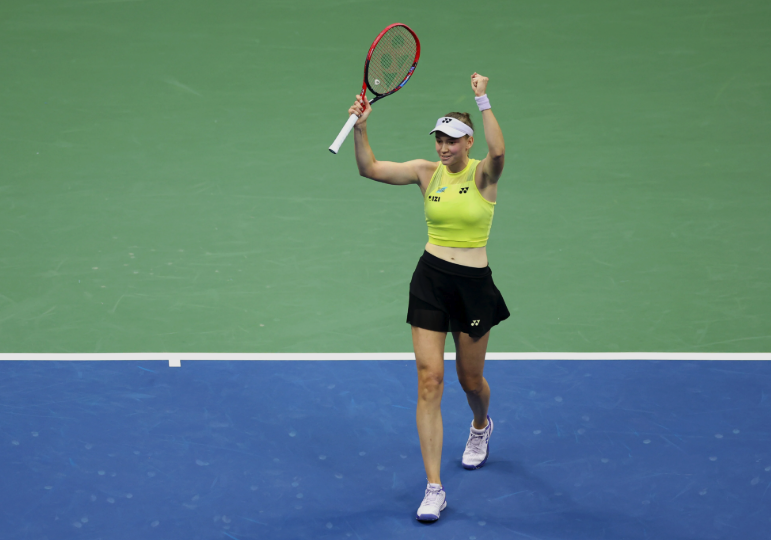
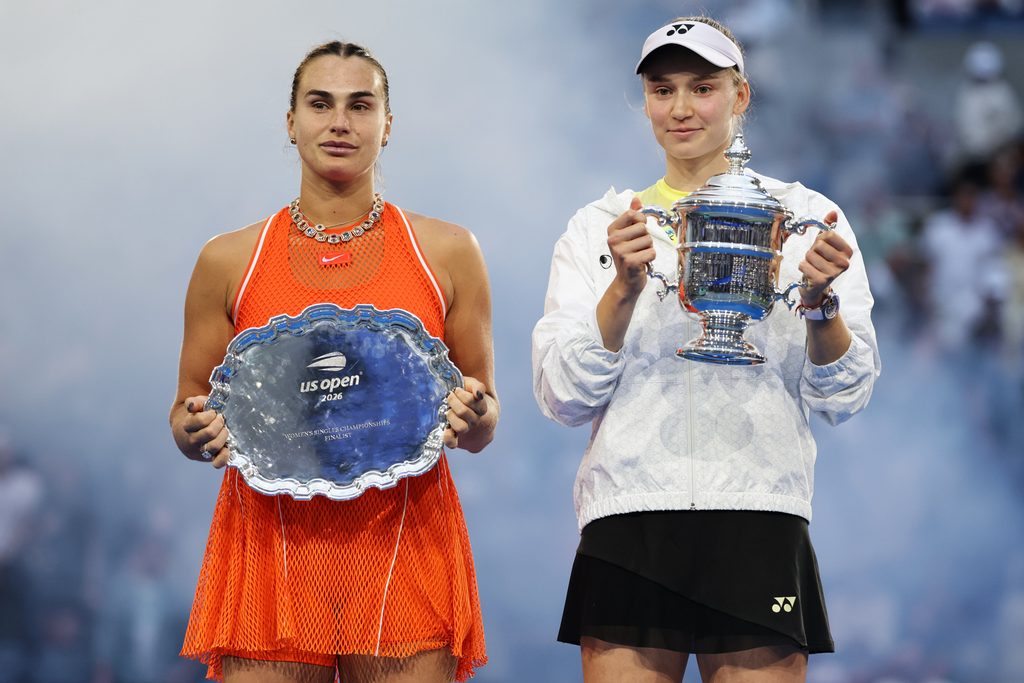
There was a moment during Saturday’s US Open final that perfectly captured the evolution of Elena Rybakina. The famously stoic Kazakh raised her arms in celebration — and for Rybakina watchers, that’s practically Marta Kostyuk doing a backflip. What began as a tournament clouded by doubts over whether she would even play, after limping out of her Cincinnati semifinal against Iga Swiatek, ended with Rybakina not only claiming the world No. 1 ranking but also snatching Aryna Sabalenka’s New York crown with a level of hitting Sabalenka simply could not match. No wonder she celebrated big.
This US Open delivered across the board: all four top seeds reached the semifinals, the top two contested the final, and the new world No. 1 justified her ranking with the title.
Rybakina’s Weapons Fire at Full Force
Rybakina owns the best serve in women’s tennis, yet she landed under 30% of her first serves in the opening set. The twist? Her second serve is also a weapon. At over six feet tall, she generates a wicked kick that’s hard to attack — though Sabalenka will surely regret the chances she had on those second serves.
What truly separated them was Rybakina’s relentless baseline pressure: deep, powerful, laser‑accurate groundstrokes that robbed Sabalenka of time. It took Rybakina several games to make her first error. Forehand, backhand, serve — everything skidded low and fast, leaving Sabalenka helpless.
Sabalenka fought admirably to stay with her in the second set, and when Rybakina tightened at 5–6, Sabalenka raised her level to force a decider. But the third set saw Rybakina return to full throttle, cracking backhands like a dream and sending groundstrokes zipping past the defending champion.
The final game summed up the match: 40–30, but not close. Sabalenka’s two points came from Rybakina double faults, and the final point was an ace — her second of the game. In truth, the match felt decided when Rybakina broke for 2–1 and held for 3–1. One break had been enough in each of the first two sets, and the pattern held. Sabalenka didn’t fight particularly hard in that last game; she knew what was coming.
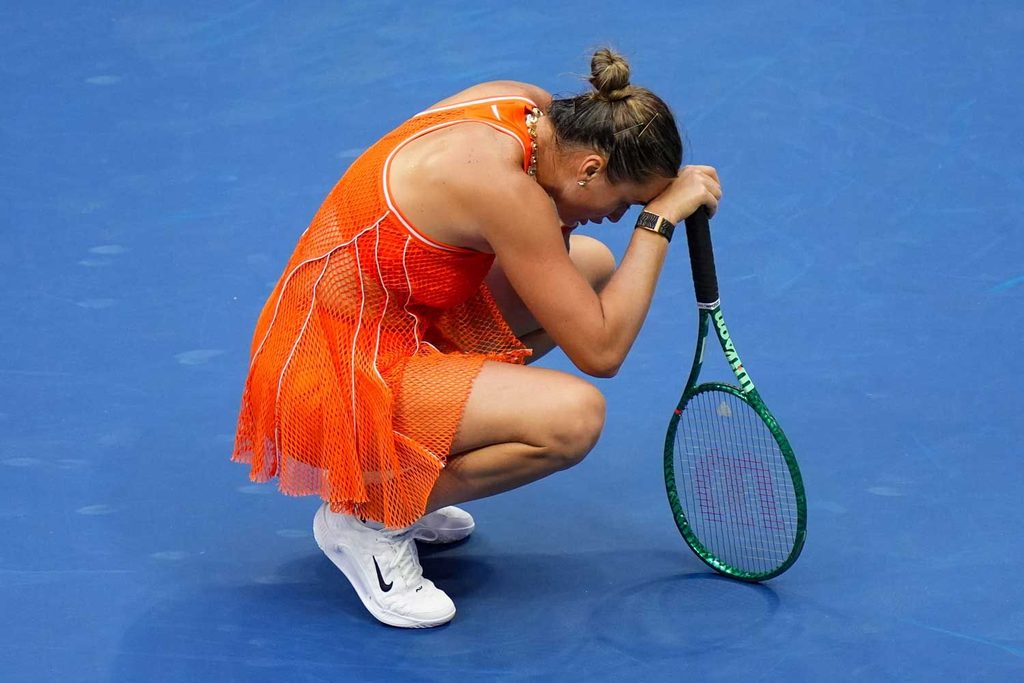
Sabalenka: A Strong Run, A Few Regrets
As a Sabalenka fan, you wanted her to get something out of a year that promised so much. But she can leave New York with few regrets. She cruised to the quarterfinals without much resistance, then played arguably the match of the tournament against Wimbledon champion Linda Noskova. Down 2–4 in the third, Sabalenka — who has lost countless tight matches this season — fought back brilliantly and sealed the win with a second‑serve ace.
Her semifinal win over Jess Pegula was even more convincing. It felt like the old Sabalenka had returned, ready to challenge Rybakina, who had already secured the No. 1 ranking regardless of the final result.
Could Sabalenka have done anything differently? Perhaps she could have backed off the baseline early or tried to disrupt Rybakina’s rhythm, but realistically, Rybakina was having one of those days. Sabalenka knows better than anyone how dangerous Rybakina can be — just think back to Brisbane 2024, when Rybakina demolished her 6–0, 6–3 and Sabalenka joked, “Thanks for giving me those three games.” This wasn’t a meltdown. It was simply a peak Rybakina performance.
Still, Sabalenka produced one unforgettable moment: that exquisite dropshot at 30–30 in the 6–5 game of set two. Worth remembering more than the racquet smashes and cursing at a cameraman! We have seen a far more stressed Sabalenka at this US Open, tetchy in press, under scrutiny and pressure to deliver. Time for her to regroup, to rebuild and come up with new strategies.
Coco Gauff: A New Appreciation
Coco Gauff could easily have made the final. She lost to Rybakina in the semis but played excellent tennis throughout the tournament. In fact, this US Open sparked a personal Gauff epiphany: her game has become genuinely enjoyable to watch.
Against Zeynep Sönmez in round one, Gauff won the first set routinely, but Sönmez turned the second into a high‑quality battle with aggressive net rushing. Watching Gauff respond with improved serving, a more reliable forehand, and confident net play made it clear how much her game has evolved. She’s no longer winning despite her technique — she’s winning because she’s developed it.
Yes, she missed a big volley on match point down against Rybakina, reminiscent of her miss against Muchová in the Wimbledon final. Gauff is good at the net but can tighten in big moments.
And she shouldn’t have even reached the semis. Mirra Andreeva had match point in the quarterfinal after coming out absolutely firing in the first set, while Gauff was all over the place! But then Mirra played the safest, meekest point imaginable when she had match point. Gauff seized the initiative, broke back, and Andreeva mentally collapsed. Gauff’s summer form has been excellent, and she had a real chance at the No. 1 ranking if she’d won the title and Rybakina had fallen early. Not this week — but it does feel like a case of when not if.
Jess Pegula: So Close, Yet So Far
Many were rooting for Jess Pegula to win her first slam. She’s been a steady top‑10 presence for years without ever quite looking like a champion. She reached the final here in 2024 but lost in straight sets to Sabalenka. Wimbledon 2026 looked promising, but she fell to Gauff in the quarterfinals.
Her form in New York was patchy. She came from a set down against both Leylah Fernandez and Emma Navarro, playing poorly in those opening sets. She started well against Sabalenka in the semis as she always does. These two usually have compelling matches, but once Aryna accelerated, Pegula had no answers.
She’s 32 and playing the best tennis of her career. If a slam is coming, 2027 feels like the window.
Other US Open Highlights
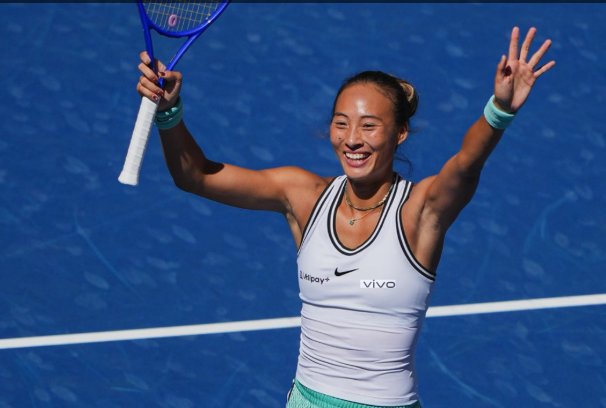
Zheng Qinwen’s Wild Ride
R3: Zheng def. Keys 1–6, 7–6, 7–5
R4: Zheng def. Swiatek 7–5, 6–3
Qinwen produced two of the tournament’s wildest comebacks: down 0–5 in the final set against Keys and 0–5 in the first set against Swiatek — winning seven straight games both times.
Keys’ collapse was brutal. She’d saved five match points the previous round and looked set for a comfortable win, but tightened with every game. Zheng, bouncing with energy, sensed blood.
Against Swiatek, the turnaround was even more baffling. Iga’s “bakery” is legendary, but she couldn’t close out the set. Swiatek has had a shaky year, and although she rediscovered form in Toronto and Cincinnati, she never found her level here. Zheng, fresh from qualifying and battling injuries all season, reached the quarterfinals and nearly upset a nervy Rybakina. She even held a break point at 4–3 in the second set — a backhand down the line she pushed long that would have left her serving for the match. Still, a brilliant week that puts her back around the top 50.
Townsend’s Drama
R3: Townsend def. Shnaider 6–2, 6–7, 6–3
Taylor Townsend and New York are a perfect match. After her dramatic run last year, she faced fellow lefty Shnaider and started really well. It looked like should would win in straight sets, serving a set and 5-3 up. She could not convert as Shnaider produced some great shots of her own. But the moment to remember was the 5–6 game in set two, where Townsend saved six set points with fearless tennis. The atmosphere was electric. Her singles run ended against Sabalenka, but bigger things were coming…
Noskova vs. Kostyuk: A Familiar Script
R4: Noskova def. Kostyuk 7–5, 5–7, 6–4
Noskova, the Wimbledon champion, had a strong US Open despite quiet showings in Toronto and Cincinnati. Kostyuk, who has been superb all year, pushed her into another dramatic three‑setter. Noskova led a set and 5–3, served for the match, choked, regrouped, and won anyway — a pattern familiar from her Wimbledon triumph. Noskova’s big game and big match nerve indicate the Czech 21 year-old might be around at the top of the game for a while. She would lose in the quarterfinal to Aryna Sabalenka but played really well in that match, hitting 18 aces, 46 winners, and 25 unforced errors (+21 ratio) and yet still lost the match. Wild.
A Glimpse of the Future
R3: Jovic def. Eala 7–5, 3–6, 7–5
Iva Jovic (18) and Alex Eala (20) produced a three‑hour Ashe night thriller that justified its prime-time billing. The Filipino diaspora has embraced Eala, and Jovic looks destined for the top 10. Not much subtlety — just fearless ball‑striking from both. The difference was probably Eala’s serve which does need a few more mph but such a fun match and two young women who are not going anywhere.
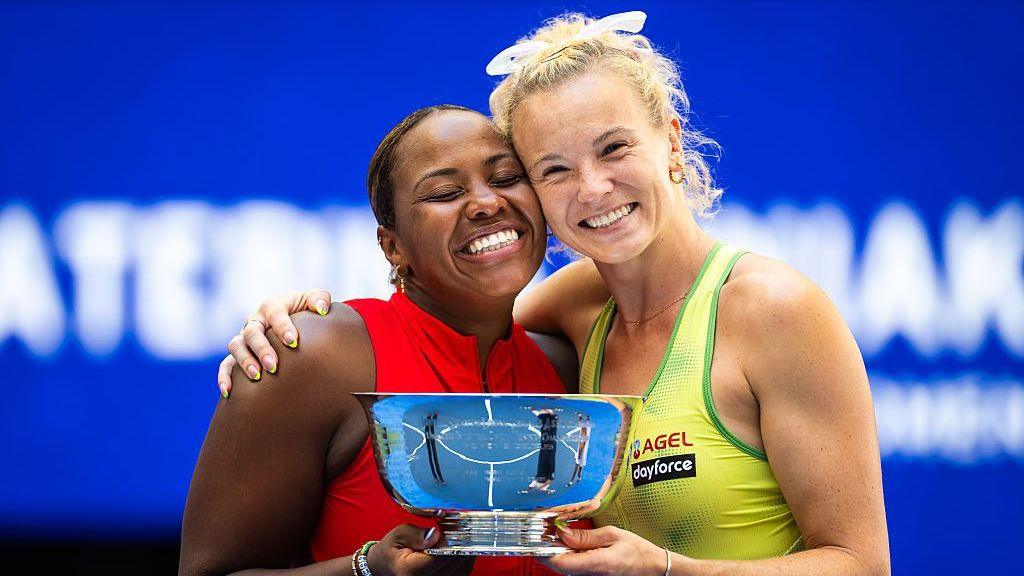
Women’s Doubles: A Career Slam Completed
F: Siniakova/Townsend def. Montgomery/Krueger 5–7, 6–0, 6–2
The women’s doubles final saw Katerina Siniakova and Taylor Townsend complete their career slam together, after winning Wimbledon in 2024, the Australian Open in 2025 and Roland Garros in 2026. Even more remarkably, this is Siniakova’s second career slam, after completing one with Barbora Krejcikova here in 2022 – where they beat Taylor Townsend and Caty McNally in the final. This is an achievement unmatched in professional tennis and further proof of the sheer class of Katerina Siniakova.
She also begins her 200th week as doubles world number 1 this week, officially moving into second place for most weeks at No. 1. Only Martina Navratilova is ahead of her on 237 weeks, and quite honestly it would be a surprise if she doesn’t take that record in 38 weeks’ time. So, mark your calendars for Monday 6th June 2027!
Taylor Townsend gets her 4th doubles slam – all with Siniakova. Katerina Siniakova adds her 12th – seven with Krejcikova, one with Coco Gauff and now four with Townsend. I hope Taylor knows how lucky she is that poor Storm Hunter ruptured her Achilles in 2024. Siniakova had made the decision to split with Krejcikova at the end of 2023 and began 2024 playing with the Aussie leftie Hunter. They had some good runs but not too many trophies. Then, in practice for the BJK Cup in April, Hunter ruptured her Achilles tendon, an injury that kept her out for the rest of the year.
By all accounts, Siniakova sent a DM to Townsend — despite not actually knowing her that well — asking if she’d like to play together. Townsend had already committed to play with Beatriz Haddad Maia in 2024, but when Siniakova asks, I guess you just can’t say no! The only problem was, Townsend then picked up an injury. After Coco Gauff’s regular partner Jess Pegula also pulled out, apparently Taylor helped set up Gauff with Siniakova, and they went on to win the Roland Garros doubles title — Coco’s first and only doubles slam to date! Taylor was back with Katerina soon after, and they won the Wimbledon crown in 2024 — an emotional first slam title for Townsend, who pre‑Siniakova had not been successful.
The final itself was not an easy one for many reasons. After a really tense and nervy start — especially from Townsend — the young wild cards Montgomery and Krueger, who have very little doubles pedigree, just played loose. However, once the number 1 seeds got going it was pretty routine, as the set scores showed, and they cruised to victory (with a little struggle in the final game!). History for both champions.
A New Era Begins
So another US Open ends. Rybakina begins her reign, while Sabalenka, Gauff, and Swiatek finish the season slamless. The top of the women’s game is fascinating, but Rybakina has shown that when she’s fit and firing, she can dominate the field. She enters a stretch with plenty of points to defend, plus the WTA Finals and Australian Open ahead. But she’s such a cool customer that you suspect she’ll handle the No. 1 mantle just fine.
Leave a Reply
You must be logged in to post a comment.