
This is a bad idea!
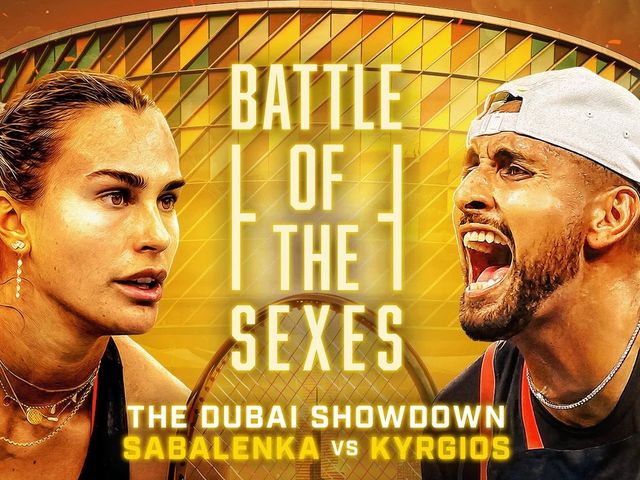
I’m a big fan of Aryna Sabalenka. I love her openness, her self‑deprecating humour, and even the moments when she stumbles. She’s no robot — she’s a fallible human being who also happens to be a terrific tennis player. But Aryna, why on earth have you agreed to this so‑called “Battle of the Sexes” match with Nick Kyrgios? WHY, WHY, WHY??!
The original clash between Billie Jean King and Bobby Riggs in 1973 mattered deeply. At that time, women couldn’t open a bank account or secure a loan without their husband’s permission. Equal prize money wasn’t even on the horizon. King had a point to prove, and Riggs — a 55‑year‑old provocateur — thrived on sexist taunts. Her victory was a landmark moment in the fight for gender equality, symbolic of women finding their collective voice.
It’s worth remembering that the restrictions women faced in the 1970s echo systems still in place today. Saudi Arabia’s male guardianship rules, where women require permission from a male relative for basic life decisions, mirror the lack of autonomy women endured in the West just a few decades ago. King’s triumph was not just about tennis — it was about dismantling a structure that treated women as dependent, second‑class citizens.
Fast forward to today. Nick Kyrgios, 30, just two years older than Sabalenka, is no Bobby Riggs. He’s not a sexist troll; he’s an equal‑opportunity irritant. Kyrgios has made a career of berating umpires, trolling on social media, and winding up opponents. Yet he’s also a gifted player: 6’4”, with a blistering serve averaging 123 mph and peaking at 143. Injuries and wrist surgery have sidelined him in recent years, but his commentary stints reveal a sharp tennis mind. And crucially, he and Sabalenka share a publicity team — Naomi Osaka’s Evolve agency.
Here’s the problem: this match is a lose‑lose for Sabalenka and for women’s tennis. Casual fans, who mostly tune in for their home Grand Slams, already see more men’s tennis simply because men play best‑of‑five sets. That extra 50% of court time shapes perceptions. When those same fans watch a lopsided women’s final — say, Iga Swiatek dismantling Amanda Anisimova 6‑0, 6‑0 in under an hour — they too easily dismiss the women’s game as inferior.
If Kyrgios is remotely fit, he should beat Sabalenka. The gimmick of enlarging one side of the court by 9% and limiting both players to a single serve hardly offsets the biological differences. Imagine the optics: the world number one losing to an unranked man. That would hand chauvinistic critics fresh ammunition. And if Sabalenka wins? Detractors will shrug: Kyrgios was injured, she had the court advantage, he wasn’t sharp. Either way, the narrative undermines rather than elevates women’s tennis.
Most importantly, there’s simply no need for this spectacle. The women’s game is thriving, with a vibrant mix of players battling for the biggest prizes. We already have mixed doubles, which showcase men and women competing together, each contributing in their own way. Remember the revamped US Open mixed doubles last year? Flawed in its player selection, yes, (Justice for doubles players!) but watching Sara Errani’s serve befuddle the men — and women grappling with those fast, spin‑heavy deliveries — was genuinely entertaining. Athletics and swimming have embraced mixed relays too, proving that co‑ed competition works when it’s collaborative, not adversarial.
Sabalenka and Kyrgios will no doubt be well compensated for this circus. My hope is that they treat it as the exhibition it should be: playful, tongue‑in‑cheek, and ultimately meaningless. Sabalenka loves a laugh, Kyrgios loves to entertain. If they lean into that spirit, fine. But if either takes it seriously, the damage will linger. Women’s tennis doesn’t need this sideshow. It needs respect for the product it already is.
Leave a Reply
You must be logged in to post a comment.